Data & machine learning 2025
Drug Repurposing
Turn biomedical associations from several data sources into a ranked shortlist for research.
- My role
- Integrated three biomedical sources, built 27 features, and trained the XGBoost and CatBoost rankers.
- Outcome
- XGBoost reached about 95% Top-5 accuracy on the project evaluation split.
- Context
- A research ranking experiment. Top-5 performance does not establish clinical effectiveness.
Problem
Prioritize candidate drug and disease associations for further research. The task combines biomedical sources with different signals and produces a ranked shortlist for experimental follow-up.
My contribution
I unified DrugBank, CTD, and BioSNAP into more than 1.2 million drug and disease pairs, roughly 1.5 GB of data, and built the 27-feature pipeline for chemical, structural, and biological signals.
I trained and tuned XGBoost and CatBoost, and supported teammates working on LightGBM and neural-network experiments.
Technical decisions
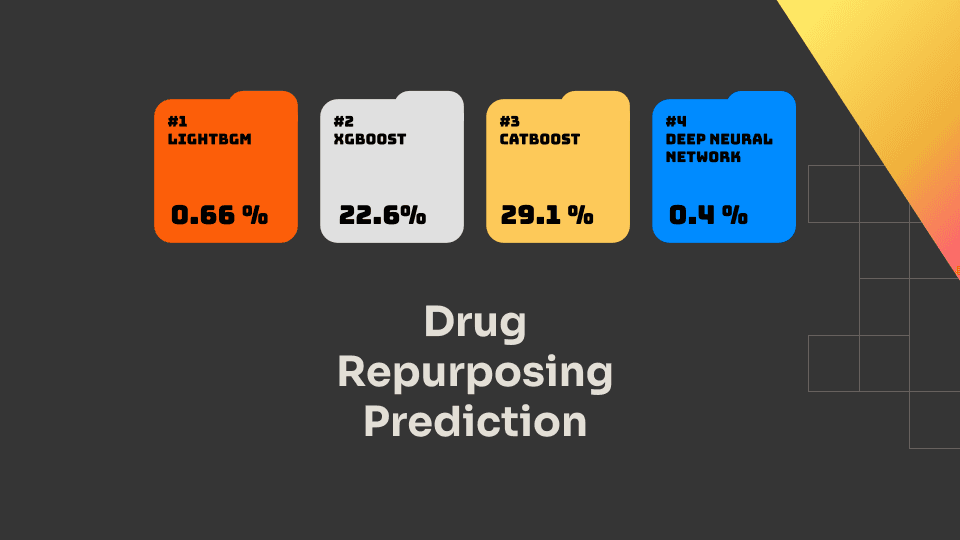
The output is a ranked list, so evaluation used Top-K metrics with a 60/20/20 training, validation, and test split. This measures whether known associations appear near the top of the candidate list, which fits the research task better than a single classification score.
Results
XGBoost performed best in the project evaluation, reaching about 95% Top-5 accuracy and about 22% Top-1. These are ranking results on the project's biomedical dataset, not clinical validation or evidence that a candidate treatment is effective.
More projects
- Local RAG App: Applied AI
- Legal One: Product engineering
- SW Habitation: Web development